Directory
Web
2025
App store privacy labels are marketing copy
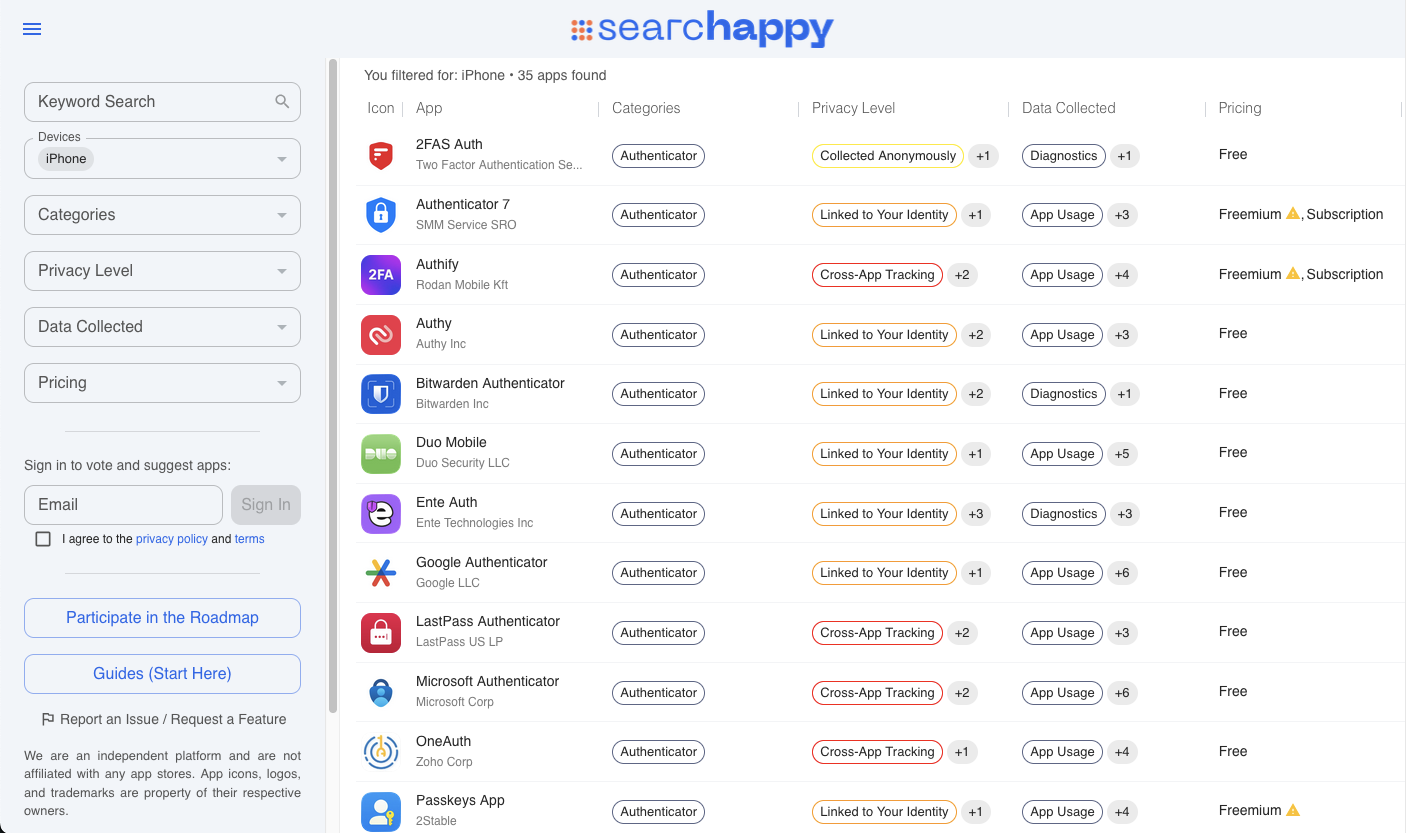
Every major app store lets developers self-report what data they collect, and almost nobody checks those claims against the actual privacy policy. Users pick apps based on labels no one verified, in stores ranked by revenue, not risk. Searchappy exists to close that gap: every listing is checked against the developer's real privacy policy, not their marketing page.
Score the data the app collects
Privacy data isn't scraped or crowdsourced — every policy is manually read, compared against the app store listing, and scored using standard criteria across multiple categories — for Apple and Google apps. Each app's privacy score is then computed automatically from that verified data and updates the moment the underlying facts change. Nothing is hand-picked, and no developer can influence their own rating.
The fine print tells the story
Most "privacy scores" are marketing copy or crowd-averaged opinions. Searchappy's rankings and filters are a result of manually verified data — no agenda, no ads, no sponsored placement to buy.
A routine security audit caught a real privilege-escalation risk before it mattered
A database-level bug briefly caused an internal outage by checking a permission rule against itself in a loop, which forced a full review of how access control was structured underneath the app. That review turned up something more serious: a gap that could have let a regular user grant themselves admin access. The team closed the loophole at the source rather than patching around it, and rebuilt the access-control layer to make the same class of mistake structurally impossible going forward.